Cobra vs Upward Dog: Which Variation Serves Your Body?
Apr 09, 2026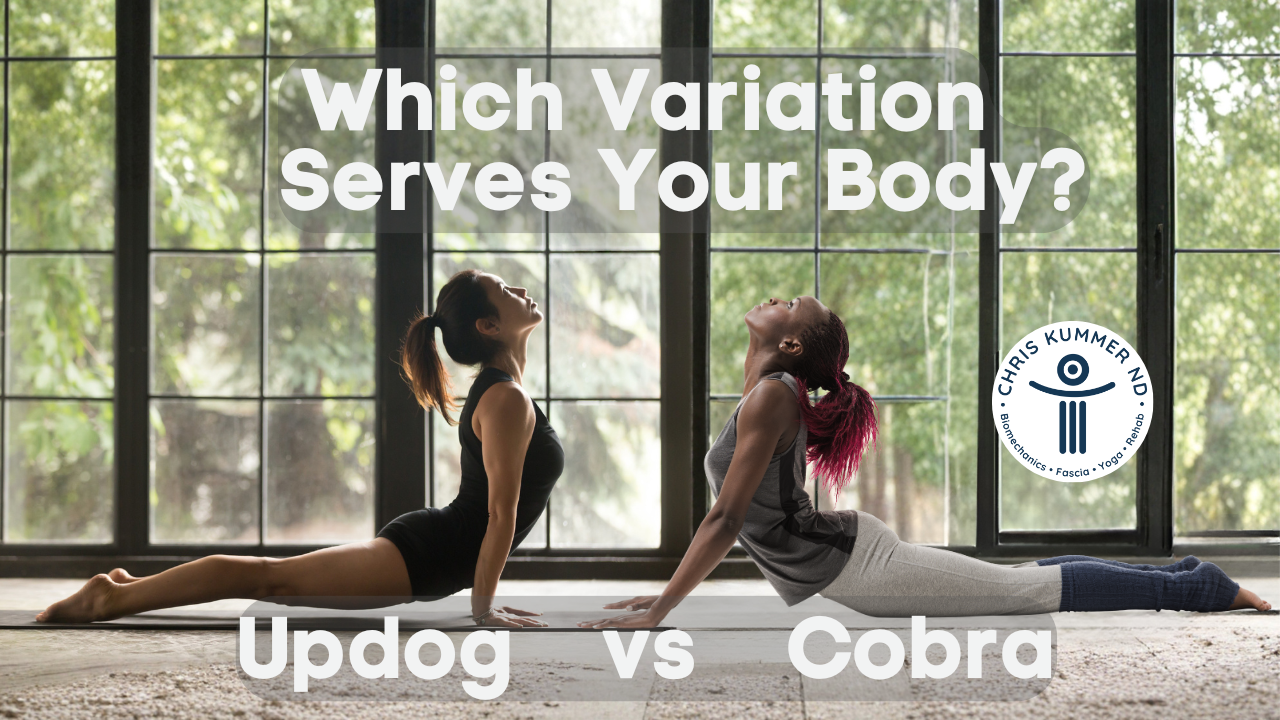
Backbends are celebrated across yoga styles for their energising, expansive, heart-opening qualities. Yet not all backbends are created equal—especially when it comes to the two poses most commonly confused and interchanged: Bhujangasana (Cobra Pose) and Urdhva Mukha Svanasana (Upward Facing Dog).
To the untrained eye, these postures might look like slight variations of the same shape. But when we examine the mechanics, load, required strength, spinal behaviour, and fascial demands, we discover two very different poses with very different effects on the body.
Understanding the difference is essential—
not only for safety, but for choosing the pose that genuinely supports your structure, your experience, and your practice goals.
Why It’s Important to Stop Treating Cobra and Upward Dog as the Same Pose
Many teachers cue Cobra and Upward Dog interchangeably in vinyasa transitions:
- “From Chaturanga, lift to Cobra or Upward Dog.”
- “Come through to your backbend of choice.”
- “Take Cobra if you need a gentler option.”
But these cues overlook something crucial:
Cobra and Upward Dog load the spine very differently.
Choosing the wrong one for your body can lead to unnecessary strain or missed benefits.
Before comparing the two directly, let’s look at each one individually.
Cobra Pose: A Supported, Accessible Spinal Extension
Cobra is often taught early in practice because it blends the benefits of spinal extension with a high degree of support and control.
What defines Cobra?
- Legs on the floor
- Pelvis on the floor
- Rib cage (usually) on the floor
- Hands lightly assisting, not pushing
- Elbows typically bent
- Low to moderate spinal extension
- The lift comes primarily from the back muscles, not the arms
What this means biomechanically:
1. The spine extends in a more distributed way
With so much of the body anchored to the ground, the spine can lengthen without hinging sharply.
2. The lower back is less vulnerable
The pelvis remains heavy and grounded, offering thick fascial and muscular support.
3. The neck remains more integrated
Because the lift is smaller, the cervical spine stays more in line with the rest of the spine.
4. The pose strengthens instead of compressing
Cobra trains:
- spinal extensors
- deep abdominal support
- shoulder stabilisers
- thoracic mobility
It’s an excellent developmental backbend.
Upward Facing Dog: A Strong, Fully Loaded Backbend
Upward Dog is visually similar to Cobra—but it is a significantly more demanding posture.
What defines Upward Facing Dog?
- Thighs lifted off the floor
- Pelvis lifted off the floor
- Rib cage lifted
- Arms straight
- Weight supported only by hands and tops of feet
- Considerably deeper spinal extension
Biomechanically:
1. The entire spine is loaded
Unlike Cobra, this is not supported by the floor. Every segment of the spine must support itself under load.
2. The lumbar spine is more prone to compression
Without pelvic support, a deep curve tends to accumulate in the lower back.
3. The shoulder girdle must be strong and stable
Weak serratus anterior, lats, or triceps lead to sagging and collapse in the chest and neck.
4. Neck mechanics become critical
In Upward Dog, dropping the head back often creates:
- cervical hinging
- vertebral artery kinking
- “seeing stars”
- jaw tension
- neck fatigue
5. The pose requires significant fascial elasticity
Especially through:
- the front of the hips
- the abdominal line
- the diaphragm
- the throat line
Without this elasticity, the spine is forced to overwork.
Comparing the Two: Key Differences That Matter
1. Load on the Spine
- Cobra: partial load; safer for most
- Upward Dog: full load; high demand
2. Strength Requirements
- Cobra: back strength more than arm strength
- Upward Dog: heavy reliance on arms, shoulders, serratus, core
3. Neck Position Safety
- Cobra: easier to maintain length; less hinging
- Upward Dog: much easier to compress the cervical spine
4. Thoracic Mobility Demand
- Cobra: encourages thoracic opening without forcing it
- Upward Dog: requires excellent thoracic mobility or risks lumbar overload
5. Common Compensation Patterns
- Cobra: tendency to push with arms instead of lift with back
- Upward Dog: lower back collapse, locked elbows, forward head drop
6. Breath Capacity
- Cobra: easier to breathe fully; rib cage anchored
- Upward Dog: breath can feel restricted if front body fascial tension is high
Which One Should You Practice?
Here’s the simplest and most accurate guide:
Choose Cobra if:
- You feel pinching in your lower back
- Your neck gets tired or compressed
- Your thoracic spine feels stiff
- You struggle to lift your chest in Upward Dog
- You’re building shoulder strength
- You want a strengthening and lengthening backbend
- You can’t maintain a long spine when straightening your arms
Choose Upward Dog if:
- You have adequate thoracic mobility
- You can keep your pelvis lifted without collapsing
- Your shoulders are strong and stable
- You can maintain length from tailbone to crown
- You can look up without seeing stars or dropping the head
- You can feel support from your core instead of sagging
And remember:
Upward Dog is not a goal. It’s a variation.
There is no hierarchy.
No badge of honour.
No spiritual advancement for lifting your legs off the floor.
There is only the question:
Which pose serves your structure right now?
A Note for Teachers: How to Make This Clear in Class
Instead of offering Upward Dog as an “advanced version” of Cobra, try reframing the cue:
“Choose Cobra or Upward Dog based on how much support you can maintain in your spine and shoulders today. Cobra is a strengthening backbend; Upward Dog is a loaded one. Both are valid.”
This builds clarity, empowerment, and body awareness in your students.
Choosing the Pose That Serves You Is Anatomy-Informed Practice
When you understand the differences between Cobra and Upward Dog, you stop trying to force your body into a pose just because the flow says so.
You begin to listen.
You begin to adapt.
You begin to choose consciously.
And that’s the foundation of a sustainable yoga practice.
If you want to explore the deeper mechanics of spinal movement, shoulder support, thoracic extension, and backbend safety, the Movement Anatomy Course offers clear, practical guidance. It’s recognised for Yoga Alliance CE credits and designed to transform the way you move and teach.
Your spine will thank you for the clarity.
This post explores both poses from a functional, anatomy-informed perspective so you can confidently decide which variation is the better choice for your spine, strength, mobility, and intention.
Are you thinking 'yeah this makes sense to me'?
Most important now is to keep your movement practice up. Maybe you want to integrate. and try out what the blog post added to your ideas. Then add to your knowledge. Keep expanding. We are always changing - stay adaptable to make the most of all the situations of your life.
JOIN MY NEWSLETTER
Subscribe to get my latest movement related content by email.
Double opt-in, please click 'confirm subscription' in your email inbox
