Should You Really “Drop Your Head Back”? Rethinking Common Yoga Cues
Apr 08, 2026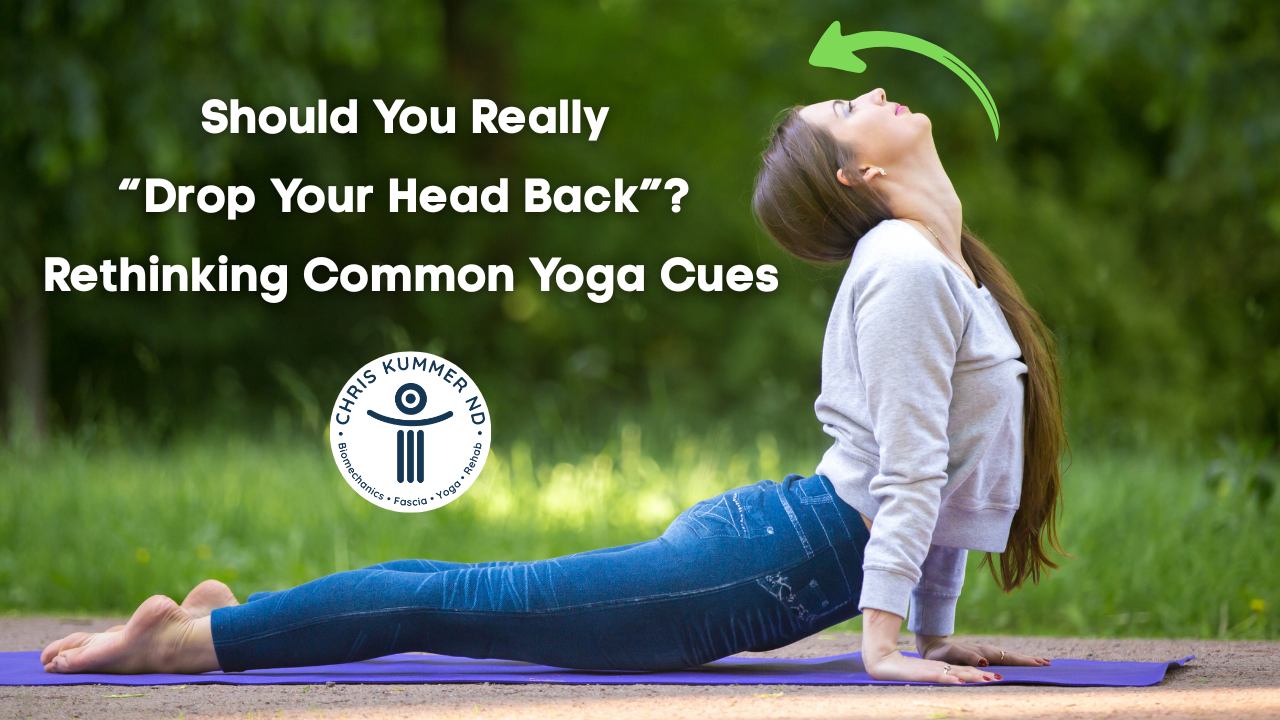
Yoga is full of poetic, memorable, and sometimes questionable cues. “Open your heart,” “shine your collarbones,” “root to rise”—they all have their charm. But one cue in particular has followed students across studios for decades:
“Drop your head back.”
You’ll hear it in backbends, in upward-facing dog, in Camel, sometimes even in standing postures. It sounds simple, expressive, and freeing. Yet for many practitioners, this instruction creates more strain than liberation.
If you’ve ever felt dizzy, compressed, pinched, or disconnected when dropping your head back, you’re not imagining things. And you’re definitely not alone.
This article unpacks why the cue often doesn’t serve most bodies, what’s biomechanically happening when the head “drops,” and how you can approach these positions with clarity, support, and confidence.
The Problem With “Dropping” Anything in the Body
When we hear “drop,” our nervous system interprets it as let go, release, or remove support.
But in backbending postures where the entire front body is lengthening and the spine is already under load, releasing support from the head and neck increases pressure exactly where we don’t want it:
- the cervical spine (neck)
- the upper thoracic hinge points
- the lower back (which often compensates)
- the vertebral arteries that supply the brain
In other words:
Dropping the head back isn’t a passive aesthetic choice—it changes the biomechanics of the entire spine.
This is especially important because the neck isn’t a separate structure floating on top of the body; it’s the continuation of the spine. However the spine curves, compresses, or hinges will directly affect what happens to the head and to the tissues that run through the cervical region.
Why “Dropping” the Head Often Leads to Compression
Let’s look at what actually happens when the head falls back without muscular support.
1. The cervical spine collapses backward
Instead of a lifted, lengthened curve, the neck forms a sharp hinge—usually at C5–C6 or C7–T1. These segments already bear more load than others, so the hinge becomes exaggerated.
2. The throat area narrows
For some people, this triggers:
- dizziness
- visual “sparkles”
- grey-out sensations
- difficulty swallowing
- pressure in the jaw or sinuses
These symptoms aren’t mystical energetic experiences—they’re physiological responses to reduced blood flow or nerve compression.
3. The vertebral arteries may kink
You might remember from the previous posts:
two of the main arteries that supply the brain run through the cervical vertebrae.
When the neck is sharply dropped back, these arteries can kink like a garden hose.
Reduced blood flow = visual disturbances.
4. The lower back takes over
If the upper back doesn’t extend well (common!), the body steals movement from the areas that move too easily:
the lumbar spine and the junction between the neck and upper back.
This results in:
- lower back pinching
- lack of space in the front body
- feeling “stuck” rather than lifted
Why Do Teachers Still Cue It?
Mostly tradition.
Many teaching lineages passed cues down verbally, long before we had accessible anatomy education. What worked for a flexible teacher or an experienced practitioner often became a universal instruction for everyone—regardless of their structure, mobility, or experience.
The intention behind the cue is good:
open the chest, expand the front body, complete the arc of the spine.
But the execution?
Often counterproductive.
Modern movement science and yoga anatomy provide a more supportive approach.
What to Do Instead: “Lift Your Head Up Into the Backbend”
The solution isn’t to avoid looking up or back.
The solution is how we get there.
Here are more functional cues that work for almost everyone:
✔️ “Keep the back of your neck long as you begin the backbend.”
This prevents early kinking and distributes movement along the whole spine.
✔️ “Let your head follow the curve, not lead it.”
The head becomes the last part to move—not the first.
✔️ “Lift your skull up and back, not down and back.”
This creates a supported arc, not a dropped hinge.
✔️ “Keep the front of the neck open without collapsing the back.”
A balanced direction of movement: length in front, support in back.
✔️ “Move your head only as far as you can still breathe easily.”
Breath is your built-in safety system.
This approach transforms the head position from a passive drop into an active extension woven into the full-body backbend.
Try This Mini Experiment
You can try this sitting or standing:
- Drop your head back fully.
Notice: tension, compression, limited breath. - Now lift through the crown of the head first, then gently arc back.
Notice: more space, less pinch, easier breathing.
That difference is exactly what you bring to your yoga practice.
How This Changes Your Backbends
By replacing “drop your head back” with supported movement, you may notice:
- less neck tension
- more thoracic extension (upper back finally moves!)
- more spacious breathing
- less pressure in the lower back
- improved circulation
- better balance in standing backbends
And perhaps most importantly:
You feel the whole spine working together—rather than one part doing all the work.
his Is Where Your Practice Begins to Transform
Understanding head and neck mechanics in backbends is one of those game-changing pieces of yoga anatomy that makes everything feel more integrated, more accessible, and more sustainable.
When we stop dropping and start supporting, the entire structure reorganizes.
This is exactly why yoga anatomy matters—not as trivia, but as a lived, felt experience improving how you move every day.
Learn More: Explore the Movement Anatomy Spine Course
If this topic resonates, you’ll love the deeper insights in the Spine Course.
It breaks down:
- how each spinal region moves
- where mobility is helpful (and where it’s harmful)
- how to build real support
- how fascia influences your posture
- how to teach and practice safely for long-term health
Recognised for CE credits with Yoga Alliance, this course helps yoga teachers and dedicated practitioners refine their movement knowledge so they can teach and practice with confidence.
When you understand the body, every posture makes more sense.
Are you thinking 'yeah this makes sense to me'?
Most important now is to keep your movement practice up. Maybe you want to integrate. and try out what the blog post added to your ideas. Then add to your knowledge. Keep expanding. We are always changing - stay adaptable to make the most of all the situations of your life.
JOIN MY NEWSLETTER
Subscribe to get my latest movement related content by email.
Double opt-in, please click 'confirm subscription' in your email inbox
