When Backbends Hurt: Understanding Lumbar Compression
Apr 07, 2026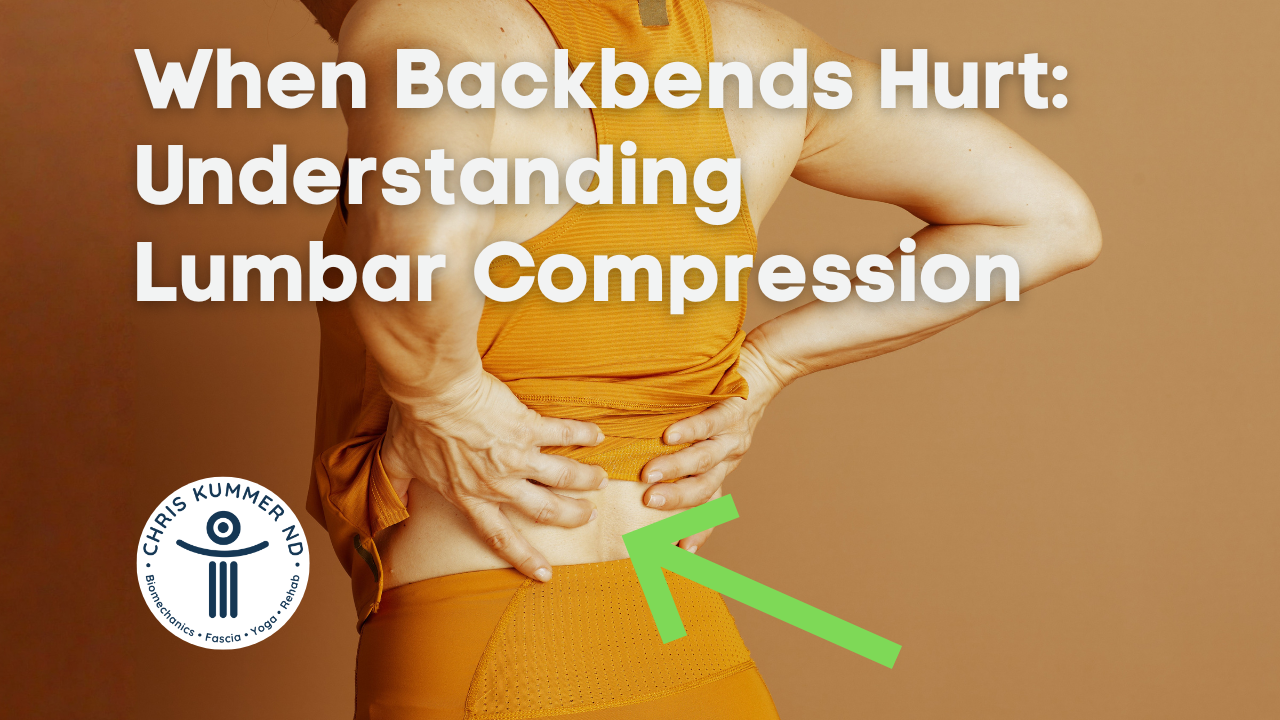
Backbends are often described as heart-opening, energizing, expansive postures—but for many practitioners, they’re anything but. Instead of lift and space, they feel pinching, crunching, or a sharp folding sensation in the lower back.
If this is you, you’re not “bad at backbending.” You’re simply meeting the limits of your lumbar spine mobility —and it’s telling you something important.
This post breaks down why backbends can hurt, what “lumbar compression” really means, and how to create sustainable, supportive extension in your practice.
What Is Lumbar Compression?
Lumbar compression happens when the vertebrae in your lower back close down on each other more than they’re designed to. This typically occurs when:
- the lumbar spine extends too much in individual joints
- the pelvis tilts forward excessively
- the rib cage moves backward instead of lifting
- the head and chin “lead” the movement
Because the lumbar spine already has a natural curve, it’s the easiest place to go when you start bending backward—so it often takes more load than it should.
Compression is not always dangerous, but repeated, unorganized compression can irritate joints, ligaments, discs, and nerves.
Why Backbends Often Go to the Lower Back First
Here’s the honest biomechanics:
The lumbar spine can extend easily—but it shouldn’t be the first or only place of movement. The thoracic spine, rib cage, pelvis, and even hip flexors all influence the distribution of backbending. When these areas don’t contribute sufficiently, the low back takes over.
Common contributors to lumbar overload:
1. Limited Thoracic Extension
If the upper or mid-back doesn’t move, the lumbar spine compensates.
This is why many people feel like they’re “hinging” at one point—usually at L4–L5.
2. Tight Hip Flexors
Restricted psoas or rectus femoris pulls the pelvis into an anterior tilt during backbends, magnifying lumbar extension.
Think: the pelvis tips forward → low back chance of compression increases.
3. Lack of Abdominal Support
You don’t need to “do a crunch” in a backbend, but you do need tensile support from the front body to create length, lift, and support, not collapse.
4. Forcing the Range
Pushing deeper because the pose shape demands it (e.g., trying to “look like the photo”) often overrides your body’s natural boundaries.
Signs You’re Experiencing Lumbar Compression
- Pinching or sharp sensation in the lower back
- Feeling “stuck” or locked at one point
- Pain after practicing backbends
- Inability to breathe comfortably
- Rib flaring or thrusting
- Standing up after a backbend and needing to “stretch” or rub the low back
Backbends should feel like space—not squeezing.
How to Reduce Lumbar Compression in Your Backbends
1. Lead With the Rib Cage, Not the Lower Back
Think of the sternum lifting up and forward, not just back.
This encourages thoracic extension, drawing some of the demand away from the lumbar area.
2. Engage the Front Body
Not bracing. Not gripping.
Just enough tone to keep the pelvis and rib cage coordinated.
Try the cue:
“Lift the front of the ribs slightly, soften the lower ribs.”
3. Use Your Glutes—But Not Aggressively
You need glute support for hip extension, but over-squeezing pushes the pelvis forward and jams the low back.
Aim for balanced glute activation, especially in glute max and med.
4. Open the Hip Flexors (But Not With Passive Stretching Alone)
You need active length, not floppy end-range stretching.
Strength-based mobility (lunges, resisted knee extension, psoas lifts) helps your pelvis stay neutral during backbends.
5. Think Long Instead of Deep
Visualise length:
- Lengthen the spine
- Lengthen the front body
- Lift the rib cage
- Reach back through space, not down into the lumbar curve
Backbends should feel “upward” before they feel “backward.”
Common Poses Where Compression Happens Most Often
- Upward Facing Dog
- Cobra Pose
- Wheel Pose
- Camel Pose
- Bow Pose
- Bridge Pose
- Locust Pose
These are not dangerous poses—just poses that reveal habit patterns.
With skill and awareness, they become some of the most freeing and joy-giving shapes in yoga.
Think of Your Lumbar Spine as a Messenger, Not a Problem
Pain or discomfort during backbends isn’t a sign you should avoid them—it’s information.
It’s your body saying:
“Hey, I’m doing all the work here. Can we share the load?”
By improving thoracic mobility, balancing pelvic position, strengthening the front body, and distributing extension across the whole spine, you can turn backbends from painful into powerful.
And more importantly—into something you can enjoy for life.
Are you thinking 'yeah this makes sense to me'?
Most important now is to keep your movement practice up. Maybe you want to integrate. and try out what the blog post added to your ideas. Then add to your knowledge. Keep expanding. We are always changing - stay adaptable to make the most of all the situations of your life.
JOIN MY NEWSLETTER
Subscribe to get my latest movement related content by email.
Double opt-in, please click 'confirm subscription' in your email inbox
