When Looking Up in Upward Dog Might Not Serve You
Mar 31, 2026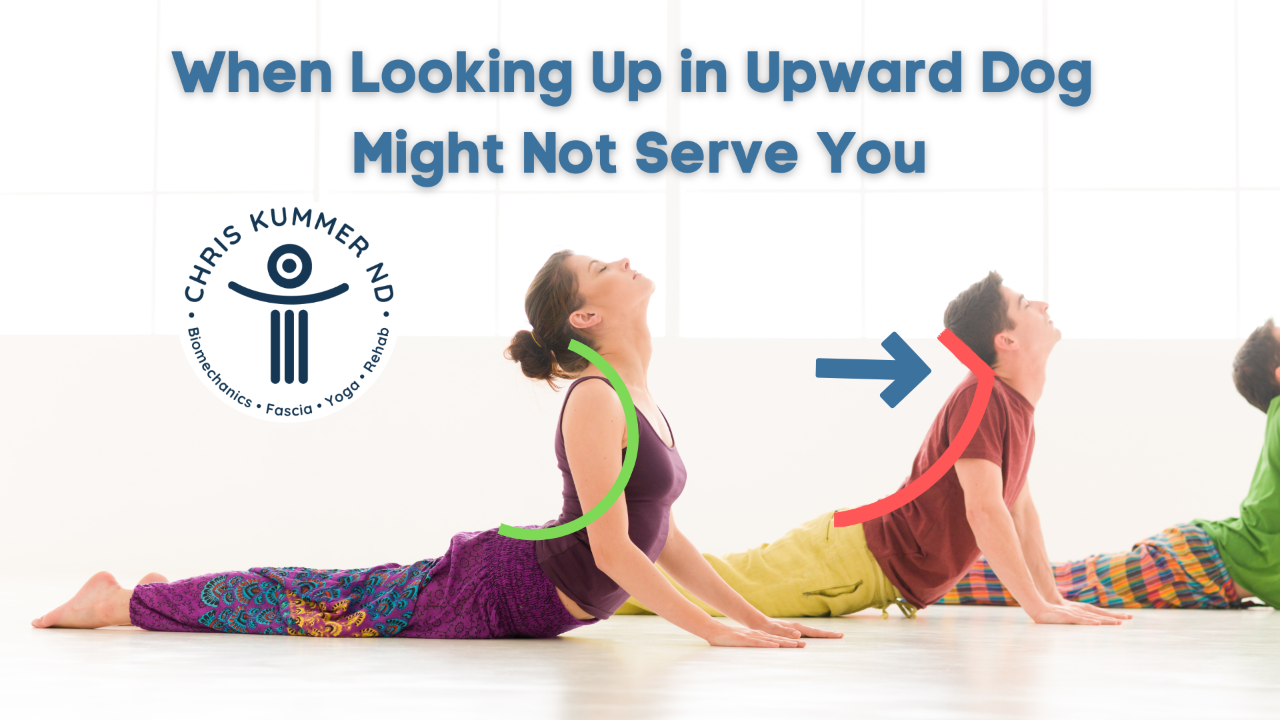
Upward Facing Dog was one of the very first yoga postures I practiced when I began taking yoga classes many years ago. It felt energizing and powerful: chest open, legs active, spine arching, the familiar compressive sensation in the lower back—and of course, the almost universal instruction to tilt the head back and look up.
Like many practitioners, I learned early on that this pose was said to stimulate the tissues and glands in the front of the neck. This sounded promising, especially because I knew so many people dealing with thyroid imbalances and hoped the pose could support them.
But over the years, as both a yoga practitioner and a naturopath specializing in structural and postural support, I began noticing something else. Many students reported that when they tilted their head back in Upward Dog, they would “see stars.” Some even described moments where their vision greyed out entirely. Teachers often made light of it, joking that these cosmic visuals were a fun bonus—added entertainment at no extra charge.
I didn’t find it funny. I found it concerning.
So I began paying more attention to the biomechanics of Upward Facing Dog and to what actually happens when we lift the head and look up.
What emerged was a combination of anatomical understanding and practical observations that can help us practice this pose more safely and more effectively.
Upward Dog Looks Different on Every Body
This might sound obvious, but it’s worth stating clearly: not everyone’s Upward Facing Dog looks the same. If you’ve ever been in a yoga class, you already know how dramatically bodies vary.
Some people slide easily into deep spinal extension. Others barely move past a gentle backbend. Some experience mobility more in their thoracic spine, while others compensate by hinging mostly at the lower back. And of course, neck posture—forward head posture being incredibly common—changes the mechanics of looking up.
The key point: the degrees of spinal extension (the actual backbend) vary enormously.
And because the neck is part of the spine, whatever is happening in the rest of the spine directly affects how the head moves.
Add in the fact that arm and shoulder position significantly influence tension in the neck, and you start to see why the simple cue “look up” doesn’t work equally well for everyone.
Compression Is Not Support
Students often describe a compressive feeling in the lower back during Upward Facing Dog. Many assume this is simply part of the pose. In reality, low-back compression is a sign that the spine is not being actively supported.
If one part of the spine is stiff or immobile, the body will often create hypermobility elsewhere to compensate. In backbends, this frequently shows up as excessive movement in the lower back or in the cervical spine—the neck. Both areas are vulnerable to compression and strain if the surrounding structures aren’t participating in the movement.
This matters especially when the head lifts and tilts back.
Seeing Stars Is Not a Bonus Feature
Let’s address the sparkles.
When the head drops back and a student “sees stars,” this is not a mystical experience, nor is it anything to ignore.
It is a sign that blood supply to the brain has been momentarily compromised.
The brain requires a constant, high-volume flow of oxygenated blood. It is supplied by six major arteries, two of which—the vertebral arteries—run through the sides of the spine in the neck. When you move your neck, these arteries move with you. Normal movement, daily activities, and most yoga postures pose no threat whatsoever to these vessels.
However, things change when the head is dropped back sharply or without muscular support.
Imagine a garden hose.
If you bend it gently, water continues to flow.
Kink it sharply, and the flow slows—or stops entirely.
The same principle applies to the vertebral arteries. A sudden, unsupported neck extension can create a kink in this section of the spine, temporarily reducing blood flow. The result? Brief visual disturbances like stars, sparkles, or greyed-out vision.
These are not “cool visual effects.”
They are signs that the brain is not getting what it needs.
Backbending Without Kinking the Spine
Upward Facing Dog and Cobra are wonderful postures for accessing spinal extension. They have the potential to:
- awaken the deep front line of the body
- stimulate the tissues of the throat and front of the neck
- open the chest
- strengthen the arms and back
- counterbalance hours of forward-bending daily habits
But these benefits come only when the pose is practiced with length, not with collapse.
A healthy backbend should create a long, continuous curve through the spine. A kink—usually happening at the base of the neck or lower back—shortens the spine overall, reduces support, and increases risk.
Depending on your spinal mobility, muscle tone, or habitual posture (especially if you have a forward head posture from computers, phones, or driving), you may need to modify how you approach looking up in this pose.
Finding Length From Tailbone to Crown
Regardless of your flexibility, one principle is universal:
A well-formed Upward Dog requires length from the tailbone all the way to the crown of the head.
This length is not passive. It requires active muscular support, especially through:
- the lower belly
- the deep spinal stabilisers
- the muscles at the base of the skull
- the serratus and upper back
- the fronts of the thighs
Next time you practice Upward Facing Dog, try this:
1. Keep your head tall as you begin.
Instead of immediately dropping the head back, imagine lifting the crown of your head upward.
2. Lengthen your lower back.
Engage your lower belly slightly and press the tops of your feet into the mat to support the pelvis.
3. Begin to look up only as far as you can maintain support.
Move slowly. You may notice there’s a comfortable range where your head lifts easily and your neck stays long.
4. Stop before your head drops back.
The moment you lose muscular control and the head “falls” into the backbend, you’ve passed your functional range and entered the zone where the arteries kink and the spine collapses.
5. Lift slightly forward and up as you look up.
This tiny adjustment—lifting forward rather than dropping back—helps keep the spine long, reduces the kink at the base of the skull, and preserves blood flow.
This is how looking up becomes strengthening rather than risky.
Movement Education Makes Everything Clearer
If this anatomy feels fascinating but also a bit complex, it’s because the spine is complex. Understanding it, however, transforms your practice.
If you want to learn how the spine truly works—what supports it, what limits it, and how to move it safely—the Spine Course is designed exactly for that purpose.
You’ll learn:
- how spinal curves actually function
- the relationship between fascia, muscle tone, and movement
- why some backbends feel wonderful and others feel pinchy
- what “support” really means during movement
- how to practice and teach safer, more effective spinal mobility
When you know what you are doing, you can do it better.
And when you do it better, your yoga practice becomes not just safer, but also more empowering and more transformative.
This course—is Yoga Alliance–recognized for Continuing Education (CE) credits, making it ideal for yoga teachers wanting to deepen their understanding and elevate the quality of their teaching.
Bringing Functional, Fascia-Based Movement Into Your Yoga Practice
Yoga is evolving. More teachers and practitioners are recognizing that sustainable practice requires understanding how the body actually works—not relying only on tradition or aesthetics.
Functional, fascia-based anatomy helps you:
- personalize poses for your own body
- prevent the wear-and-tear that comes from repetitive unsupported movement
- teach or practice with more clarity
- build a stronger and more resilient spine
- improve your students’ experience instantly
Upward Facing Dog is just one example of how a small shift in understanding can change everything. Instead of kinking the spine, cutting off blood supply, or compressing the lower back, you can practice the pose with strength, intelligence, and long-term support.
Learn how the spine was meant to move—and how your practice can help it thrive.
Are you thinking 'yeah this makes sense to me'?
Most important now is to keep your movement practice up. Maybe you want to integrate. and try out what the blog post added to your ideas. Then add to your knowledge. Keep expanding. We are always changing - stay adaptable to make the most of all the situations of your life.
JOIN MY NEWSLETTER
Subscribe to get my latest movement related content by email.
Double opt-in, please click 'confirm subscription' in your email inbox
